

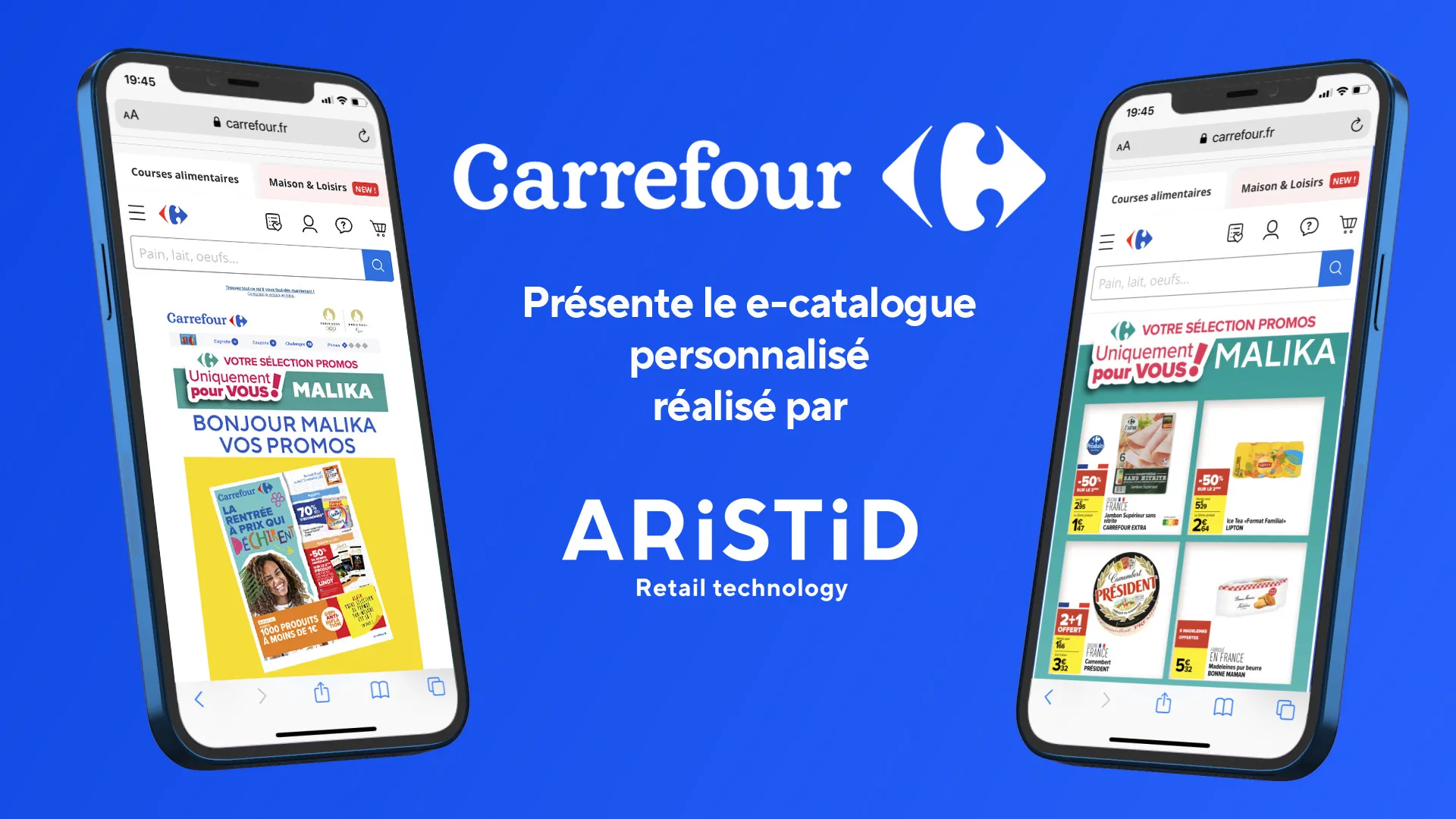
ARISTID ENABLES CARREFOUR TO OFFER EACH OF ITS 14 MILLION CUSTOMERS A PERSONALIZED VERSION OF ITS PROMOTIONAL CATALOG
The distribution of the printed catalog dropped in mailboxes is living its final hours. At the very moment when French shoppers are looking for the best promotional offers to protect their purchasing power…
To offer each of its customers offers that match their needs, CARREFOUR has created with ARISTID the very first “personalized E-catalog”.
Why is it urgent for CARREFOUR to rethink its catalog?
While the advertising catalog is still THE preferred medium for French shoppers to spot “good deals”, its current distribution is being heavily challenged today.
- The legal framework of the Climate Law and the OUI PUB scheme, in trial since September 2023 in 11 large urban areas, significantly limits its distribution in printed form.
- Added to this is the surge in paper prices, which is increasing production and distribution costs.
- Lastly, the social perception of print media, considered far more polluting than its digital counterpart, and the limited appeal of mailboxes for younger generations, who prefer digital platforms.
At the same time, the digital version of the catalog — the well-known digitized e-catalog — has already become familiar, and the addition of digital functions for sorting, adding to basket and creating favorite lists has already won over many CARREFOUR customers.
However, one feature was missing from this tool: PRODUCT RECOMMENDATION.
For many years, CARREFOUR has built up a deep understanding of its customers: their product preferences, the promotions that drive purchase, and much more. Until now, the brand had not been directly connected to commercial personalization. Promotional offers were mainly distributed via mass media — powerful, but uniform and untargeted.
Today, this digital behavior, now a must-have on marketplaces and in e-commerce, has become commonplace in the customer journey.
It was therefore crucial for CARREFOUR to be able to offer all its customers a unique and personalized promotional experience that takes the best of the catalog, in terms of how the offer is presented, and combines it with the ultra-precise customer knowledge of the brand with the most stores in France.
Thanks to the technological approach driven by ARISTID, we are now able to redeploy our commercial creativity. This will allow us to leave the era of the paper catalog without losing the bond with our customers. We are going to create new promotional stories which, I'm sure, will be appreciated and will help generate more traffic in our stores.
— Frédéric PRESLOT, Operational MKG Director CARREFOUR
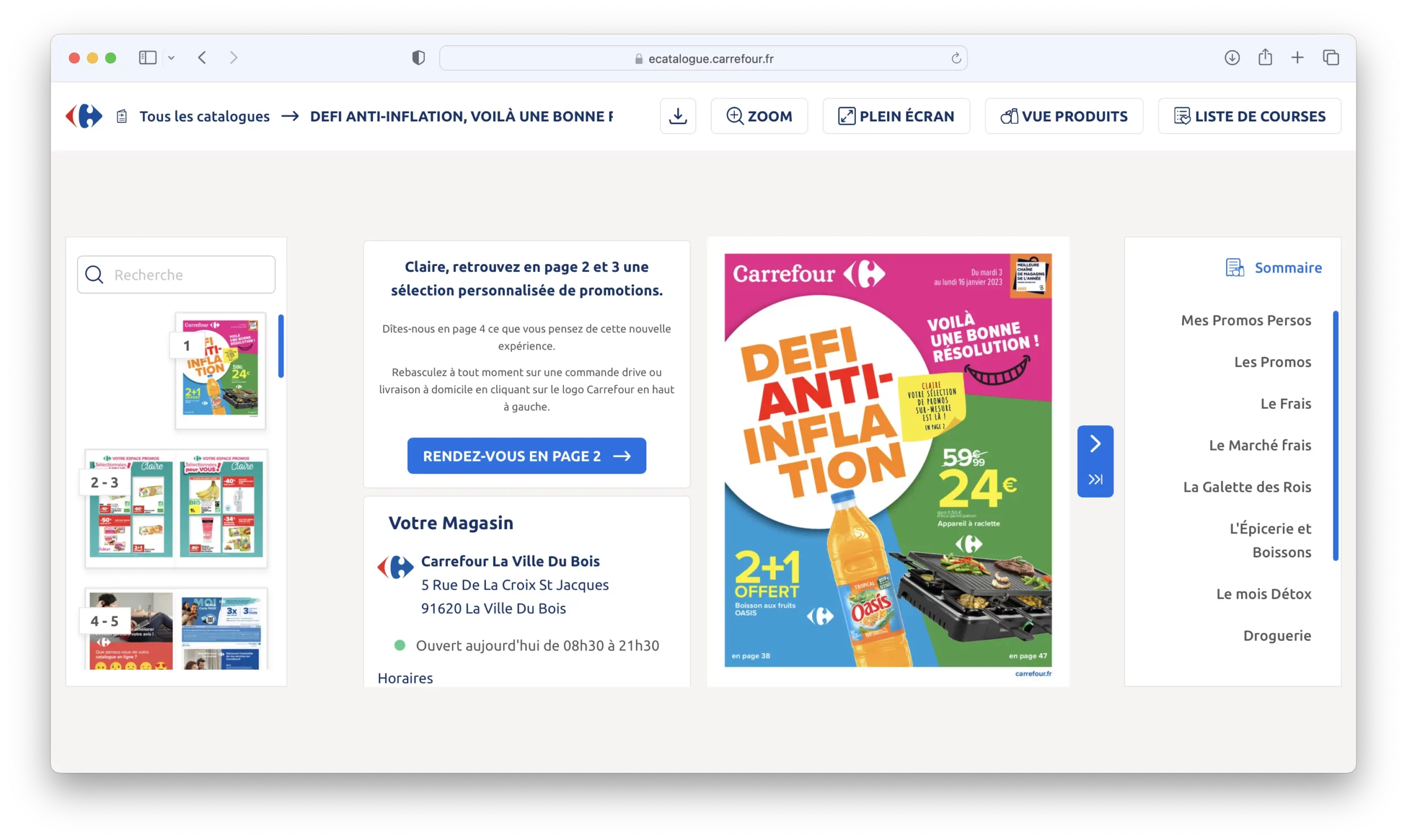
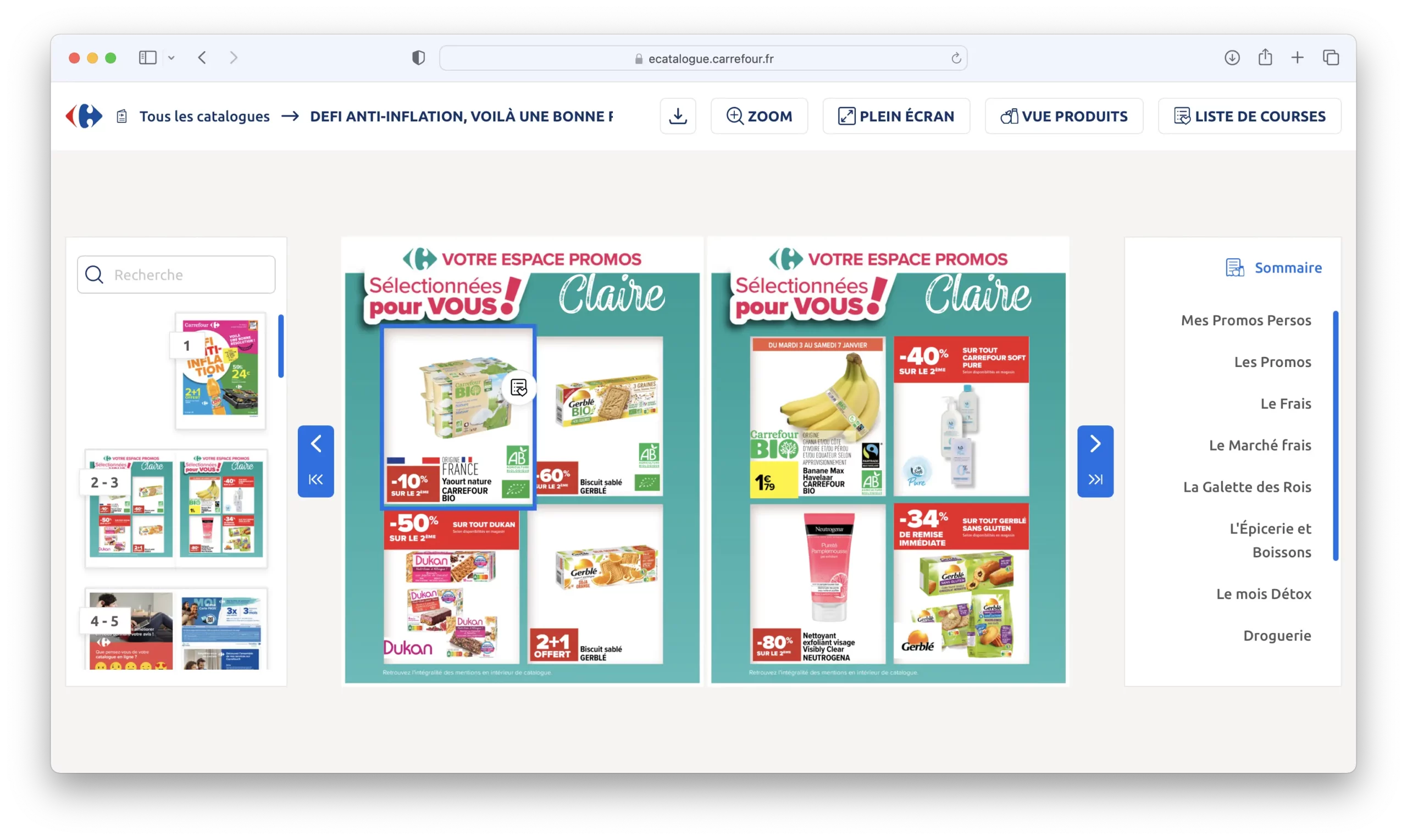
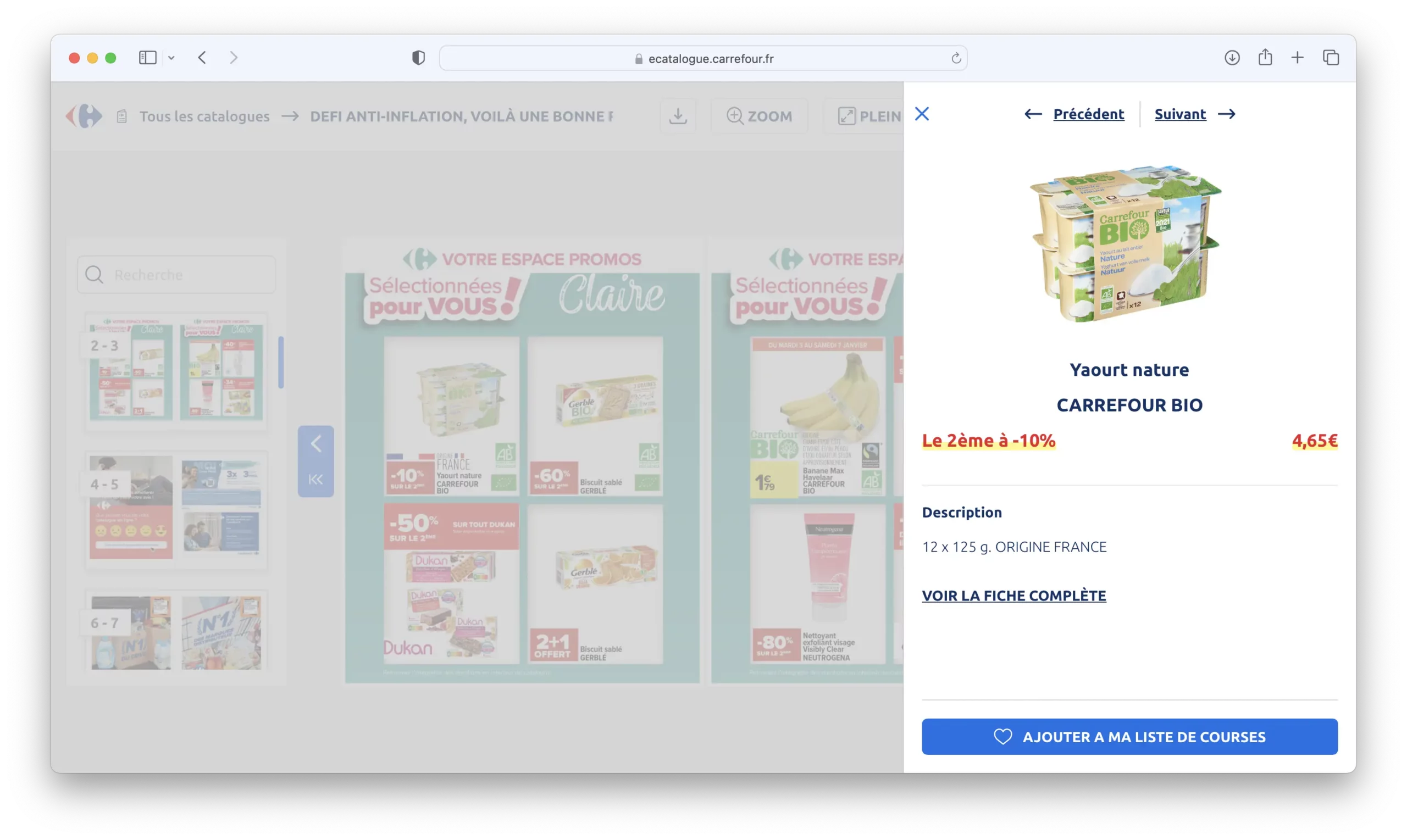
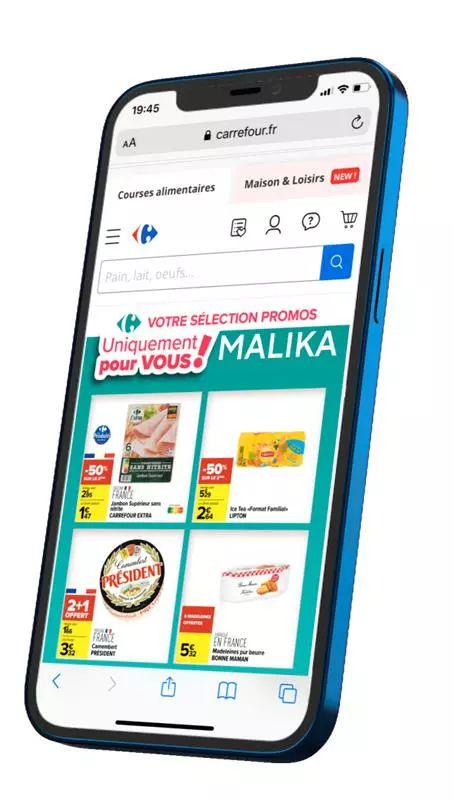
Offering a personalized offer to millions of customers is a real challenge
To take on this challenge, Carrefour relied on its technology partner ARISTID. ARISTID Retail Technology is a French company, publisher of software solutions dedicated to mass retail. ARISTID has been supporting CARREFOUR for 5 years on the digital transition of all its communication processes.
Thanks to all the technological architecture put in place by ARISTID, it is possible for CARREFOUR, for the first time, to cross-reference the full richness of its “Big customer data” with its “Offer data lake”. This allows it to produce, at very large scale, an unlimited number of fully personalized commercial offers.
This feat is all the more impressive in that it is also enriched by store data, giving France's leading retailer the ability to offer each of its 14 million customers the right product, presented with the right promotion, at the right moment, via the channel of their choice, and at the price of their preferred store.
This “data-centric” revolution completely repositions the way commercial communication is built — until now very static and entirely centered on the print catalog and its physical distribution.
The personalized e-catalog, a first step towards individualized promotion
Thanks to these developments, Carrefour and ARISTID envision a multitude of creative uses for this ultra-personalization.
Customer scenarios can be much more precise, more qualitative, more relational; every form of expression is possible and every distribution channel can be used. This technological feat makes commercial proposals far more relevant and helps reduce advertising overload.
The CARREFOUR personalized catalog, launched in September 2022 with a portion of the retailer's customers, foreshadows the future of commercial advertising.
The first results of this experiment also show strong public adoption: 6.53% interaction rate vs 2.78% for non-personalized, and +17 points of NPS score from the very first wave in September 2022.

We are very proud to support CARREFOUR in the constant evolution of its processes. The personalized e-catalog project is a great example of complementarity between the offer data we help CARREFOUR structure and the customer data, which is retailers' real treasure!
— Rodolphe Bonnasse, CEO ARISTID Retail Technology
The personalized e-catalog in figures — May 2023
The Carrefour x ARISTID collaboration
- 30K catalog pages created per year
- 300K in-store product displays
- 100% automatically digitized
- 4,000+ stores connected
According to Frédéric Preslot, several factors justify the shift to the digital leaflet. “When we stopped distributing paper catalogs in mailboxes during the first tests we ran in 2021, we immediately felt that the catalog landing page and our reader would be a key topic, because that was where we were naturally redirecting all our customers.”
The personalized e-catalog concerns 3 million people
The figure of 3 million is an average; some weeks reach 4 million and others 2.5 million. If no relevant offer exists, the customer's catalog is not personalized: there is no fake personalization. Each week, Carrefour customers find out by email whether the e-catalog is personalized or not.
ARISTID's technological setup really makes it possible to produce, in a 100% automated way, with no friction, with no manual or human action from the Carrefour teams.
— Rodolphe Bonnasse, CEO ARISTID Retail Technology
The scale of the technological challenge
On one side, between 500 and 800 promotional offers; on the other, 14 million customers and more than 4,000 stores able to host different prices. The number of available options is enormous. It is impossible to imagine the personalized e-catalog without a heavily industrialized technological foundation.
What results?
We had asked our customers to rate their experience on the traditional reader with the classic catalog. Then we asked them the same question when they received the personalized catalog, and we gained 17 points of NPS (Net Promoter Score). We even doubled the click-through rate.
— Frédéric Preslot, Operational Marketing Director CARREFOUR FRANCE
The email click-through rate is doubled when the leaflet is personalized
The paper leaflet forced us to have a single national price. But this kind of system allows us to consider commercial agility both in terms of performance with customers and in terms of negotiation or even margin calculation and steering across your network.
— Rodolphe Bonnasse, CEO ARISTID Retail Technology
And what comes next? The personalized e-catalogs also allow Carrefour to be more agile in pricing, negotiation and margin control, which could make it possible to have different promotions and promotional prices according to location: Marseille, Bordeaux, Toulouse, Lille or Strasbourg.
LSA report — How does Carrefour personalize its digital leaflets? / Yves Puget, 19 January 2023
The battle has only just begun…
To offer each of its customers offers that match their needs, Carrefour has created a personalized e-catalog. Decoding.
“We want to say yes to all our customers”, hammers Frédéric Preslot, Operational Marketing Director at Carrefour.
That is, yes to those who no longer want to receive leaflets in their mailbox and aren't looking for promotions. Yes to those who still want promos but are looking for alternatives to paper. And yes to those who still need paper, even if it means sending the catalog by post. “We won't leave anyone by the side of the road. Our progressive reduction of catalogs in mailboxes, launched more than 18 months ago, did not target paper but its waste. Our goals are clear: to cut the number of paper catalogs by 40% in 2023 and by 80% by 2024!”
Working on relevance
Of course, the paper catalog has advantages at the start of this equation, since everyone ends up opening their mailbox. And when Carrefour started to digitize its communication, it had to acknowledge that the number of people exposed to digital was lower than those owning a mailbox.
The idea is fairly simple: bring up to the front pages of the catalog and make stars of the eight products most frequently bought by each customer. To safeguard the customer experience, if the recommendation engine cannot find at least four customer-specific products in the catalog, there is no personalization. Today, almost 1.1 million customers receive an email this way every week. The click rate doubles and reaches 6% as soon as the catalog is personalized.
Email is the favorite
The movement is well and truly under way, with a first personalized catalog sent in September 2022. More than 180 stores have already stopped distributing leaflets, particularly in Paris and Lyon, and many more have joined since the beginning of January.
Two catalogs raise questions: the toy catalog and the wine fair. In September 2022, catalogs were therefore slipped into postal invitations to the wine fair evenings. For toys, the brand is considering distributing them at the till, with email notifications letting customers know that the catalog has arrived.
Local business in the spotlight
And tomorrow, it is conceivable to go even further in personalization. With more targeted units of need (UN), but also with targeted promotions.
“We are only at the start of catalog personalization. But it can only be done with an industrial model”, warns Rodolphe Bonnasse.
Retailers' customer data has more value than the algorithms of the major GAFA. To know one tenth of what retailers know about their customers, these digital giants have to invest billions of euros. “We are the keepers of the temple of this promotional data.”
Five tips for digitizing your catalog, by Rodolphe Bonnasse, President of ARISTID Retail Technology
- Make sure your promotional data is robust. Otherwise, at every exposure (app, web, mailing, leaflet, store…), you will have to spend money and time bringing it up to standard.
- Have data that is accessible, i.e. in a single place. If it is the result of a co-built effort drawing from different units in the company, it will quickly become a nightmare to manage and keep up to date.
- Make sure that the entire creation system for materials (PDF, JPEG, video files…) is built on an industrial automated generation setup.
- Have a solid customer database with an appropriate recommendation engine. So a good CRM system.
- Have a technological setup that is open and compatible with this digital ecosystem to avoid managing conversions and format-specific adjustments for every medium.
Olivier Dauvers — Carrefour, one step ahead on promo personalization / 15 May 2023

“Don't lose a single customer or a single euro of revenue”. Carrefour's mantra in its approach to promo digitization has the merit of being simple and clear. Committed to an 80% reduction in paper volume by the end of 2024, the group is also progressing on the personalization of digital leaflets since autumn 2022 to encourage its customers to make the switch.
On this front, Carrefour clearly has a step ahead, with the help of ARISTID, its provider for leaflet solutions, both paper and digital. The two lifted the lid during a morning dedicated to promo digitization organized by Meta on Thursday.
Out of Carrefour's 14 million loyalty cardholders, around a quarter already receive a personalized email highlighting the 8 — even 12 — most relevant offers from the week's leaflet based on their consumption habits. If fewer than 8 products are relevant, the email then directs to the standard e-catalog. This is to avoid undermining the personalization promise, which addresses a strong customer expectation: “personalized” emails are clicked twice as often as those pushing the “omnibus” leaflet. And the optimized reading experience scores 17 points of NPS more than the non-personalized reader.
In parallel, Carrefour is following its plan for the progressive end of leaflets: by the end of June, 35 Carrefour stores and 290 Markets will have completely stopped distributing leaflets. That's roughly 15% and 30% of the two networks. Compared with the 200 Leclerc stores already at zero leaflets (270 in July), before the major leap on 1 September.
Thanks to Olivier Dauvers for this article on our collaboration with Carrefour. Read the original article
Explore further
The martech & promotional data puzzle: Why retailers struggle to see the full picture
Retail organizations build the easy edge pieces of their martech stack first. ARISTID helps retailers connect the fragmented middle into one unified promotional ecosystem.

ARISTID earns the trust of France’s leading sporting goods retailer, Intersport
INTERSPORT France, the country’s leading sporting goods retailer, has expanded its partnership with ARISTID after a successful first year of collaboration. By adopting ARISTID’s end-to-end promotional marketing platform, the retailer now manages promotional planning, content production, creative automation and campaign execution through a unified technology ecosystem. The partnership highlights how large retail networks can modernize promotional operations while improving efficiency, consistency and speed-to-market.

ARISTID 2026 retail trends report: The world’s most innovative retail concepts
9th edition of Rodolphe Bonnasse's world tour of retail: social shopping, AI, engagement and storytelling flagships.
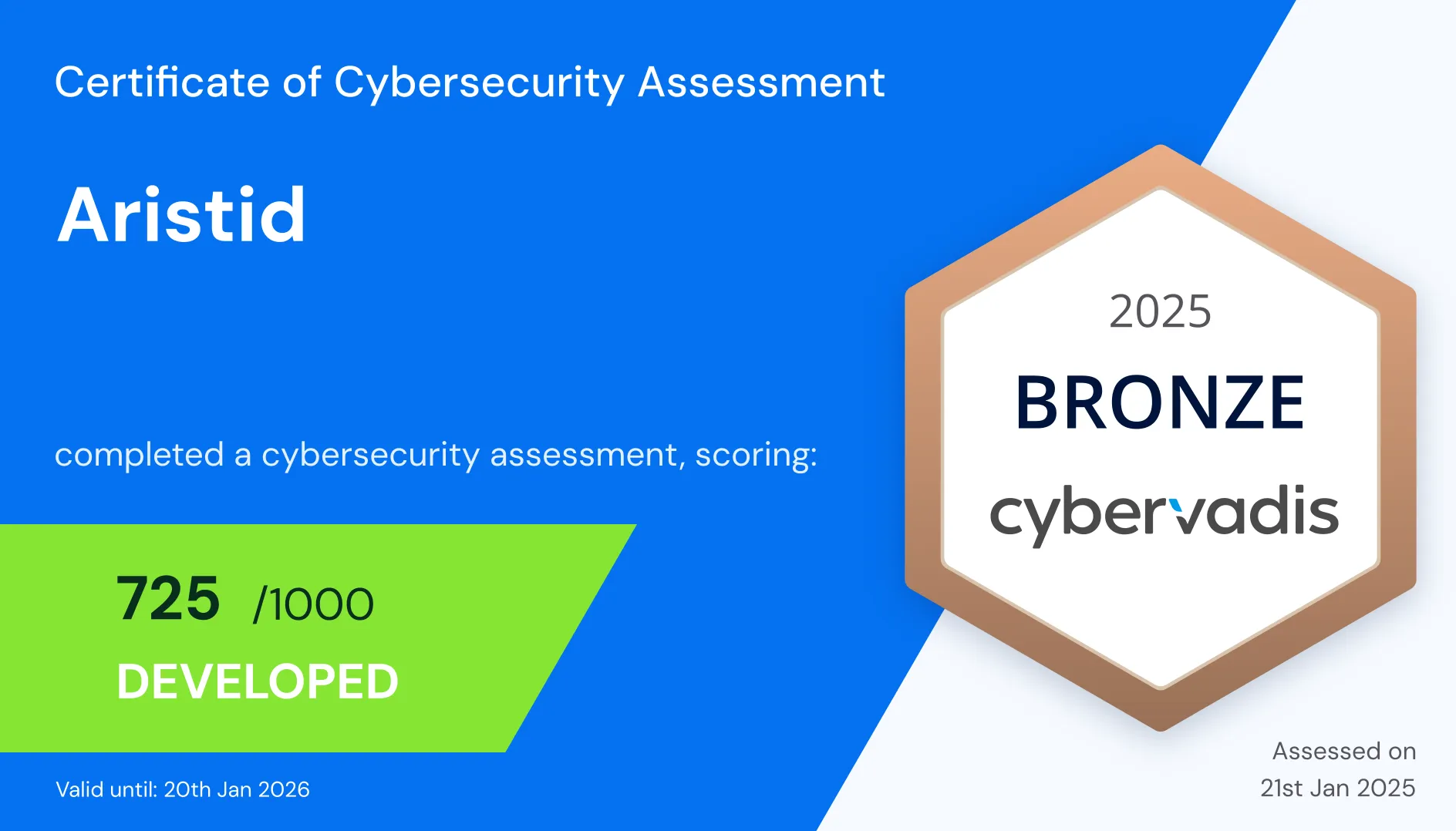
ARISTID achieves a Bronze score of 725 on CyberVadis
ARISTID earns a Bronze score of 725 on CyberVadis, recognising the robustness of its cybersecurity processes and controls.

Catalog digitalization guide 2.0 by Alliance Digitale
ARISTID contributes to Alliance Digitale's Catalogue Digitalisation Guide 2.0, unveiled at the Drive-to-Store 2025 morning event.

8th edition of our retail trends report
8th edition of Rodolphe Bonnasse's retail world tour: AI, augmented reality, sustainability and inclusive retail.

ShopAdvizor x ARISTID: Integrating customer reviews into promotional materials
Carrefour displays customer reviews on its catalogues, e-catalogues and in-store signage thanks to SHOPADVIZOR x ARISTID.

You have not yet ##optimized## your communication processes